
Ekron (Tel Miqne) - A Philistine Power City Rejecting The Ark

Ekron (Tel Miqne)
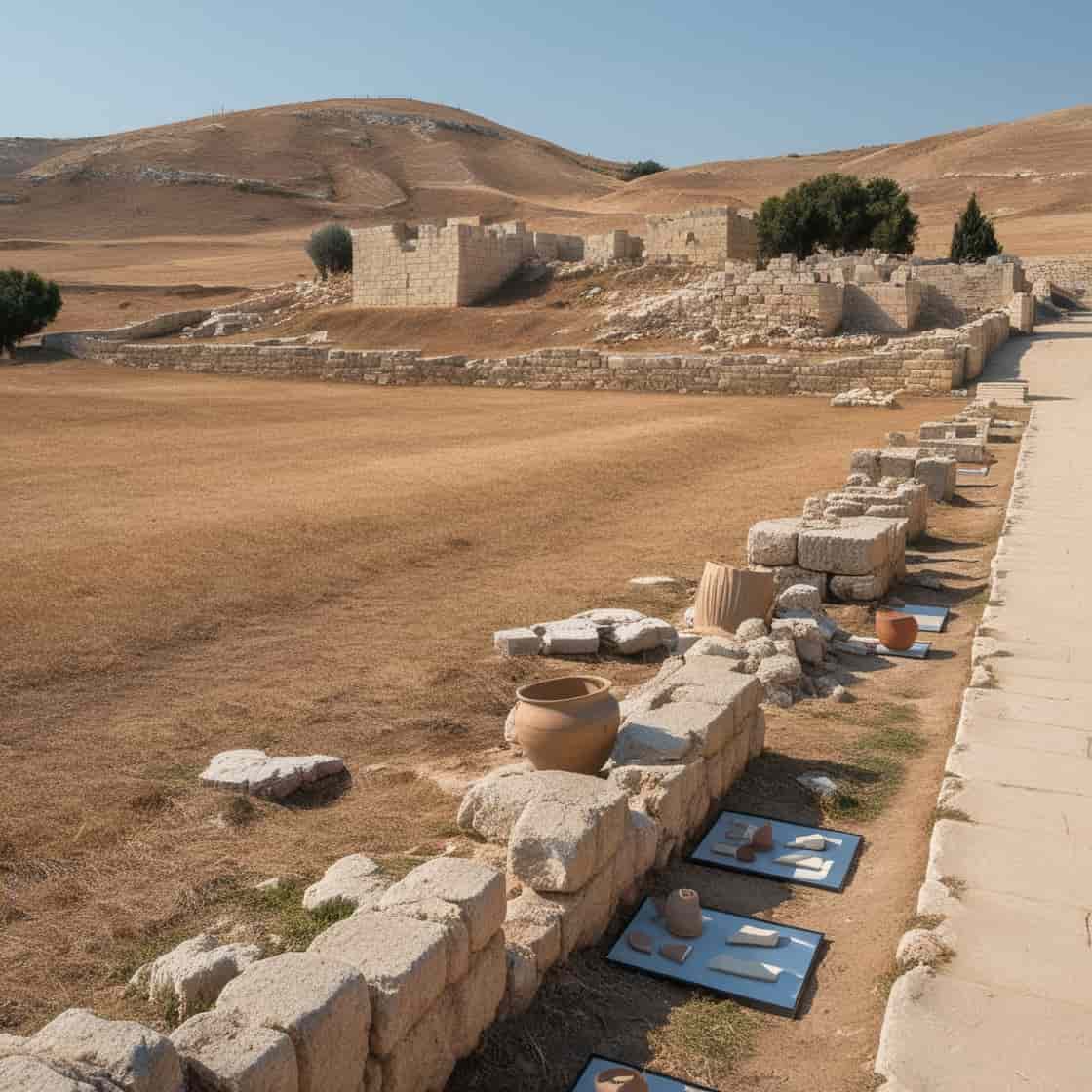
Nestled in the rolling hills of the Shephelah near Beth Shemesh, where the coastal plain meets the Judean foothills, lies Tel Miqne Ekron. This impressive 50-acre archaeological site, located just 35 kilometers southwest of Jerusalem, has revealed itself to be none other than the biblical city of Ekron. As one of the five principal cities of the Philistine Pentapolis, Ekron played a pivotal role in the geopolitical landscape of Canaan during the Iron Age ii. The excavations at Tel Miqne have confirmed its identity as ancient Ekron and revolutionized our understanding of Philistine culture, challenging long-held assumptions and offering new insights into this fascinating civilization.
I've had the privilege of witnessing firsthand how Tel Miqne-Ekron brings history to life. From its monumental olive oil production facilities to the groundbreaking royal inscription that bears its name, this site continues to captivate scholars and visitors alike. Join me as we explore the remarkable story of Ekron, a Philistine powerhouse that has emerged from the depths of time to reshape our view of Eretz Israel.
The History of Ekron (Tel Miqne): From Philistine City to Modern Archaeological Site
The journey to identifying Tel Miqne as ancient Ekron began with Nathan Edlin, a member of Kibbutz Revadim, who first suggested the connection. This hypothesis was confirmed through extensive archaeological excavations conducted between 1980 and 1997 by a joint expedition of the Hebrew University and the Albright Institute.
These excavations revealed a rich stratigraphic sequence:
- The site was initially settled by Canaanites in the 13th century BCE.
- From the 12th century BCE, it came under Philistine control.
- In the 8th century BCE, under Assyrian influence, Ekron became a major center for olive oil production.
- The city reached its peak in the 7th century BCE but was ultimately destroyed by the Babylonian king Nebuchadnezzar in 604 BCE.
Tel Miqne-Ekron's story begins over 3,000 years ago, during the tumultuous period following the Bronze Age collapse. As one of the five major Philistine cities that formed the famous Pentapolis, this ancient Ekron played a crucial role in the geopolitical landscape of ancient Canaan and Israel. The site's rich history spans from the early Iron Age to the 7th century BCE, with particularly significant developments during the Iron Age II period.
The site's history is a tapestry of different cultures and influences. From its origins as an early Philistine city to its later periods under Assyrian, Babylonian, and Persian rule, Tel Miqne-Ekron's layers tell a complex story of ancient Near Eastern civilizations.
Location and Geographical Significance of Ekron (Tel Miqne)
Situated about 35 kilometers southwest of Jerusalem, near the modern Kibbutz Revadim, Ekron occupies a strategic position on the border between the coastal plain and the Judean foothills. This location made it a key player in the region's trade routes, connecting the Mediterranean coast with the inland kingdoms.
The site itself is very impressive, about 50 acres. As you stand atop the ridge at Tel Miqne-Ekron, you can easily imagine how this Philistine city once dominated the surrounding landscape, its fortifications a testament to its power and importance.
Major Archaeological Discoveries at Tel Miqne Ekron
The Tel Miqne Ekron excavations have yielded a treasure trove of artifacts and structures that have revolutionized our understanding of Philistine culture. One of the most significant finds is the extensive industrial zone dedicated to olive oil production. The scale of this operation is truly amazing, at its peak in the 7th century, Ekron was producing more olive oil than anywhere else in the Middle East!
But it's not just about economics. The material culture unearthed at Tel Miqne, including distinctive pottery styles and evidence of iron smelting, provides crucial insights into Philistine daily life and technological advancements. The excavations have revealed multiple strata, with Stratum IV being particularly noteworthy for its wealth of findings.
The Ekron Inscription: A Groundbreaking Find
In 1996, archaeologists at Tel Miqne-Ekron made a discovery that sent shockwaves through the academic world: the Ekron Royal Dedicatory Inscription. This find is nothing short of extraordinary – it's the first archaeological evidence that explicitly names the site as Ekron and lists five of its rulers.
The inscription, dedicated to a goddess named Ptgyh, not only confirms Tel Miqne's identity as ancient Ekron but also provides valuable information about its political structure and religious practices. As someone who's had the privilege of seeing this inscription up close, I can tell you it's a truly awe-inspiring artifact.
Ekron (Tel Miqne)'s Role in Philistine Culture and Economy
Tel Miqne-Ekron wasn't just any Philistine city – it was an economic powerhouse. The extensive olive oil production facilities I mentioned earlier are a testament to this. At its height in the 7th century BCE, Ekron was producing an estimated 1,000 tons of olive oil annually, a staggering amount for the time.
But Philistine Ekron's significance goes beyond economics. The city was a melting pot of cultures, showcasing influences from the Aegean, Egypt, and the local Canaanite traditions. This cultural fusion is evident in everything from architectural styles to cultic practices, including the possible worship of deities like Baal Zebub.
Ekron and the Ark of the Covenant
During the 11th century BCE, as described in the Book of Samuel, the Israelites faced increasing pressure from the Philistines. In one significant battle, the Israelites lost the Ark of the Covenant, which then brought disaster upon its captors. The Philistines in Ashdod, stricken by a plague, quickly sent the Ark to Gath, only for the same misfortune to strike there. Desperate to rid themselves of the cursed object, the people of Gath passed it on to the city of Ekron. However, the Ekronites, aware of the Ark’s power, refused to bring it into the city and instead left it in a field nearby.
After seven months of suffering, the Philistines constructed a special carriage to return the Ark to the Israelites in Beth Shemesh. The Ark eventually found a home in Solomon's Temple in Jerusalem, though its ultimate fate remains a mystery to this day.
The Destruction and Abandonment of Tel Miqne-Ekron
Like many ancient cities, Ekron's story is one of rise and fall. The city reached its zenith in the 7th century BCE under Assyrian rule, possibly during the time of King Sargon II. However, this prosperity was short-lived. In 603 BCE, during the seventh century BC, the Babylonian king Nebuchadnezzar II laid siege to Ekron, resulting in its destruction and eventual abandonment.
Walking through the ruins of Tel Miqne-Ekron today, you can still see evidence of this violent end – layers of ash and debris that mark the city's final moments.
Modern Excavations and Research at Tel Miqne-Ekron
The modern chapter of Tel Miqne-Ekron's story began in 1981 when systematic excavations of the site commenced. Led by renowned archaeologists Trude Dothan and Seymour Gitin, these excavations have continued on and off for decades, each season bringing new and exciting discoveries.
The Tel Miqne-Ekron excavation project has been a collaborative effort involving institutions such as the W. F. Albright Institute of Archaeological Research and the Hebrew University of Jerusalem. Scholars like S. Gitin, T. Dothan, and more recently, Yosef Garfinkel, have made significant contributions to our understanding of this site.
As a tour guide, I've had the opportunity to speak with some of the archaeologists working at Tel Miqne-Ekron. Their passion and dedication to unraveling the site's mysteries are truly inspiring.
Biblical Significance of Ekron
Ekron holds a special place in biblical narratives, particularly in the tumultuous period described in the Book of Samuel. One of the most famous stories involving Ekron relates to the Ark of the Covenant. After the Philistines captured the Ark from the Israelites, it brought plagues upon the cities where it was kept. When the Ark was sent to Ekron, the people, aware of its reputation, refused to let it enter the city. Instead, they placed it in a nearby field for seven months before arranging its return to the Israelites at Beth Shemesh.
Another significant biblical reference to Ekron involves its association with Baalzebub, The Book of Kings recounts how Ahaziah, king of Israel, sought counsel from this deity's oracle in Ekron when he fell ill, an action that drew condemnation from the prophet Elijah.
But what's truly fascinating is how archaeological findings at Tel Miqne-Ekron have both supported and challenged our understanding of biblical texts. It's a perfect example of how archaeology and textual studies can work together to paint a more complete picture of the past.
Visiting Tel Miqne-Ekron: What to Expect at the Archaeological Site
If you're planning a visit to Tel Miqne-Ekron, prepare to be amazed. While it may not have the monumental architecture of some other sites in Israel, what this ancient Philistine city offers is a genuine glimpse into the everyday life of an ancient city.
As you walk through the site, you'll see the remains of the city's fortifications, industrial areas, and public buildings. The olive oil production facilities are particularly impressive – you can still see the massive stone weights used in the oil presses! The elite zone of the city, with its unique architectural features, provides insights into the social structure of Philistine Ekron.
Tel Miqne-Ekron's Legacy and Its Impact on Our Understanding of Ancient Philistia
The discoveries at Tel Miqne-Ekron have fundamentally changed our perception of Philistine culture. Far from the crude barbarians often portrayed in popular culture, the Philistines of Ekron were sophisticated urban dwellers with a rich material culture and extensive international connections.
The ongoing research at Tel Miqne Ekron continues to yield new insights. Recent studies by scholars like Alexander Zukerman and M.W. Meehl have further enriched our understanding of this important site. Their work, along with contributions from institutions like the Penn State University Press, ensures that Tel Miqne-Ekron remains at the forefront of research into Philistine culture and the ancient Near East.
For me, Tel Miqne-Ekron represents the best of what Israeli archaeology has to offer – a site where history comes alive, challenging our preconceptions and offering new insights into the ancient world.
Touring Ekron (Tel Miqne)
Although most of the archaeological discoveries at the site are now concealed, Kibbutz Revadim offers a chance to experience some of its past through replicas displayed along the “Philistine Street.” These exhibits provide visitors with a fascinating look into the region’s rich Philistine heritage.
For a more immersive experience, you can book a trip to Ekron with a guided tour of the Shephelah.
ORDER NOW!

SLAVA BAZARSKY
PHONE: +972 53 4779797
Tours in Israel
- 11 Days Jewish Heritage Tour through Israel
- 3-Day Israel Tour for Seniors - Walk Through the Bible
- 3-Day Jewish Heritage Tour of Israel: Unveiling the Rich Tapestry
- 4 Day Israel Tour Package for Seniors - Easy Individual Pace
- 5 Days Jewish Heritage Tour to Israel: A Journey Through History and Spirituality
- 5-Day Israel Private Tour Package For Seniors With Discounts
- 6-Days Israel Private Tour Package for Seniors
- 7 Day Jewish Heritage Tour to Israel: A Holistic Journey
- 7-Day Israel Tour for Seniors: Discovering History and Culture
- 9-Day Jewish Heritage Tour Through Israel
- Best Israel Tours for Seniors lead by #1 private tour guide
- Christian Holy Land Guided Tour of Israel 2026
- Classic Guided Israel Tour
- Holy Land Tours For Seniors From The USA With Price And Reviews
- ISRAEL: OFFICIAL TOURING ENTRY FOR FAMILIES, SMALL GROUPS COVID 19
- Jewish Heritage Guided Tour
- Volunteer and Solidarity Trips to Israel | 2026/2027 Mission Tours
Daily Tours in Israel
- BATTLE LEGACY TOUR
- Best 3-Day Negev Jeep Tour - Mystery of The Israeli Desert
- Best Eilat to Petra 1 Day Private Tour
- BETHLEHEM AND JERICHO PRIVATE DAY TOUR FROM JERUSALEM & TEL AVIV
- CALIBER 3 GUSH ETZION - ULTIMATE ISRAELI MILITARY ADVENTURE
- CHRISTIAN GALILEE TOUR
- CHRISTIAN JERUSALEM TOUR
- CITY OF DAVID AND UNDERGROUND JERUSALEM TOUR
- CLASSIC PRIVATE JERUSALEM TOUR
- Dead Sea and Masada Private Guide Day Tour, Reviews & Price
- Dead Sea and Masada Private Guided Tour for Seniors
- Dead Sea Relaxation Day Tour
- HAIFA, AKKO AND ROSH-HANIKRA TOUR
- Half Day Tour To Bethlehem From Jerusalem With A Local Guide
- Jerusalem Private Tour for Seniors with Cost & Reviews
- Jerusalem Rooftops And Walls Private Tour: History From A Different Angle
- JORDAN RIVER BAPTISM SITE TOUR
- Judean Desert Area Private Tour - Hiking and Off Road Jeep
- Kibbutz Beeri Solidarity Tour - Support and Volunteer
- Kibbutz Nir Oz Solidarity Tour - Witness October 7th Dark Events
- Levinsky Market Ultimate Tasting Private Tour
- Northern Israel Solidarity Tour: Kiryat Shmona, Kibbutzim & Golan Heights
- October 7th Gaza Envelope Memorial Tour from Tel Aviv | Bear Witness
- Private Tour to Nazareth and Capernaum for Seniors
- Private tours of Acre, Caesarea and Haifa from Tel Aviv Israel: Reviews, Price
- Private Tours of Jerusalem and Bethlehem from Tel Aviv Israel: Reviews, Price
- Private Vip Tour Of The Israel Diamond Exchange Center in Ramat Gan
- RAMAT GAN SAFARI PARK TOUR
- SAFED AND GOLAN HEIGHTS TOUR
- Senior-Friendly Private Tour of Caesarea and Haifa
- TEL AVIV AND JAFFA PRIVATE TOUR
- Tour of the Shephelah for Seniors: Beit Govrin, Maresha, Burma Road
- Touring Nova Music Festival Site, Sderot, The Burnt Cars Compound, And Other Sites Around Gaza Strip Following The 7.10.23 Hamas Attack