
The Royal Tombs of Petra Jordan: Facts and Tours

The Royal Tombs of Petra: Majestic Unesco World Heritage Site Monuments
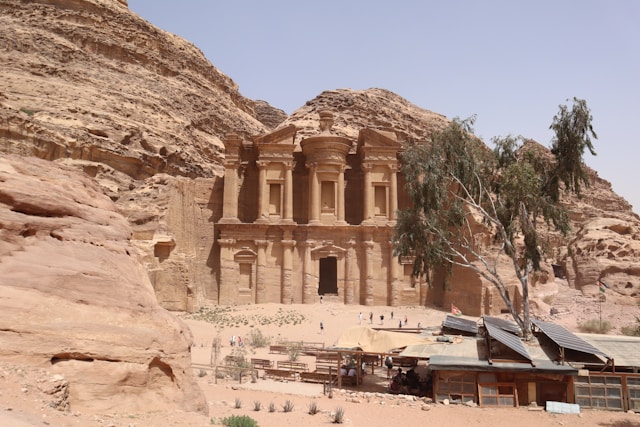
The Royal Tombs of Petra, built by the Nabataeans around the 1st century CE, stand as masterpieces of ancient engineering along the western face of Jabal al-Khubtha. These monuments in Petra, including the Urn, Silk, Corinthian, and Palace Tombs, showcase the sophisticated craftsmanship of Nabataean stonemasons who transformed solid rock into elaborate burial chambers for their elite.
With facades rising to 45 meters and adorned with Hellenistic-influenced columns, pediments, and decorative elements with royal context, these structures represent the pinnacle of Nabataean architectural achievement. Their strategic position overlooking Petra's city center reflects their importance in ancient Nabataean society, where they served both as royal burial places and as public monuments demonstrating the kingdom's wealth and cultural refinement.
The Royal Tombs of Petra: History and Legacy
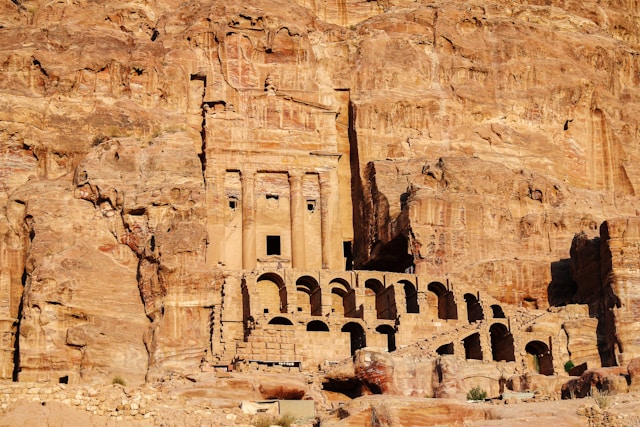
The Royal Tombs of Petra were constructed during the peak of Nabataean prosperity in the 1st century AD, approximately 2,000 years ago. The Nabataeans, originally nomadic Arab traders, established Petra as their capital around the 3rd century BC. By the time these tombs were commissioned, the Nabataean Kingdom had developed into a wealthy trading empire controlling vital commercial routes connecting Arabia, Egypt, Syria, and the Mediterranean.
The scale and elaborate decoration of these impressive tombs reflect the wealth and status of their intended occupants—the Nabataean royal family and elite. Unlike Egyptian pharaohs who built their tombs in secrecy, Nabataean royalty constructed their final resting places as public monuments, designed to impress both citizens and foreign visitors and to perpetuate their legacy.
Recent archaeological evidence suggests the Nabataeans incorporated elements from multiple architectural traditions. Their exposure to Hellenistic, Roman, and Egyptian styles through trade resulted in a distinctive fusion evident in these magnificent structures—a testament to their cultural sophistication and cosmopolitan outlook.
The Four Majestic Royal Tombs of Petra
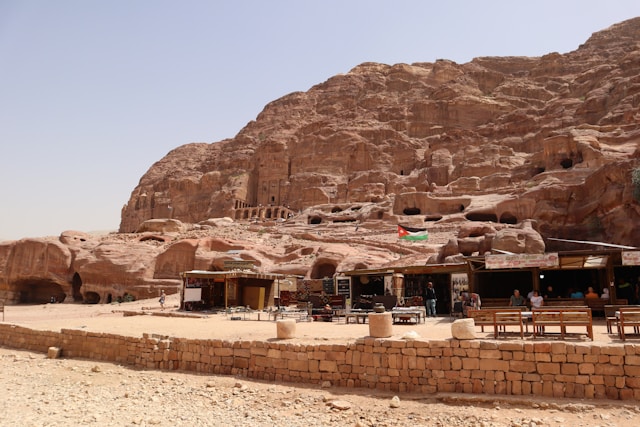
1. The Urn Tomb in the Royal District
The most prominent and accessible of the Royal Tombs, the Urn Tomb, commands attention with its imposing façade measuring 26 meters wide by 16.49 meters high. Historians believe it likely belonged to King Malchus II (who died in 70 AD) or possibly King Aretas IV, one of Petra's most successful rulers.
To reach the largest tomb structure, visitors must ascend a grand staircase leading to a spacious colonnaded courtyard. This courtyard served as a gathering space for funeral ceremonies and commemorative rituals. The tomb's name derives from the large urn that crowns its pediment, symbolizing the final repository of the deceased.
The interior features a single large chamber with three small burial niches carved into the rear wall. What makes this tomb particularly fascinating is its later repurposing as a Byzantine church in 447 AD—a conversion recorded in a Greek inscription still visible on the rear wall. This adaptation included the addition of three apse niches, transforming the pagan tomb into a Christian place of worship and demonstrating how sacred spaces evolved through different religious traditions.
The Urn Tomb's elevated position offers visitors one of the most spectacular panoramic views across Petra's city center, making it not only architecturally significant but also a premier vantage point for photography enthusiasts.
2. The Silk Tomb: Nature's Canvas
Next to the distinctive Urn Tomb stands the so-called Silk Tomb, distinguished by its extraordinary natural coloration. While smaller in scale, it captivates visitors with the mesmerizing swirls of vibrant red, pink, yellow, and white sandstone that give it its name—reminiscent of flowing silk fabric.
The natural mineral deposits in the sandstone have created these dramatic chromatic patterns over millennia. Iron oxides produce the reddish hues, while manganese creates purples, and calcium carbonate contributes whites and yellows. These colors are most vivid in the early morning or late afternoon sunlight when the angle of illumination enhances their intensity.
Unlike its neighbors, the Silk Tomb's interior chambers are relatively simple, suggesting it may have belonged to a noble rather than a monarch. Nevertheless, its extraordinary exterior makes it one of the most photographed structures in Petra and a testament to the Nabataeans' appreciation for natural beauty in their architectural choices.
3. The Corinthian Tomb: Classical Inspiration
Following the Silk Tomb along the cliff face, the Corinthian Tomb presents a façade that, when originally complete, rivaled even the famous Treasury in grandeur. Measuring 27.55 meters wide and 26 meters high, its design reflects significant Hellenistic influence, with distinctive Corinthian-style pilasters adorning its façade.
This Nabataean tomb derives its name from these Corinthian elements, which demonstrate the Nabataeans' familiarity with classical Greek architectural orders. Experts believe this tomb dates to approximately 40-70 AD, during the period when Nabataean culture was increasingly influenced by Roman architectural conventions.
At the base of the façade, observe the four ritual water basins—essential elements for purification ceremonies that preceded entry to the tomb. The interior contains four separate chambers, suggesting it may have housed multiple royal family members. The sophisticated water management system connected to these basins further illustrates the Nabataeans' mastery of hydraulic engineering, a skill that enabled their civilization to thrive in this arid environment.
The Corinthian Tomb has suffered significant weathering over the centuries, but its remaining features still provide valuable insights into Nabataean funerary practices and their cultural assimilation of foreign artistic traditions.
4. The Palace Tomb: Imperial Ambition
The northernmost and most elaborate of the Royal Tombs, the Palace Tomb represents the pinnacle of Nabataean architectural ambition. Its massive three-story façade extends 49 meters across and rises 45 meters high, designed to evoke the appearance of a Roman imperial palace, specifically inspired by Emperor Nero's Domus Aurea in Rome.
The upper level features a broken pediment, while twelve columns originally adorned its central section. The lower level includes eight columns framing four separate doorways, each leading to its burial chamber. This complex design suggests it may have served as a communal mausoleum for an extended royal lineage or perhaps the final resting place of Petra's last independent king.
In front of the Nabatean tomb lies a spacious courtyard with what appears to be a stage area, indicating this space hosted elaborate funeral ceremonies and possibly recurring commemorative rituals. The size and complexity of this structure reflect not just the wealth of the Nabataean elite but also their aspirations to architectural grandeur on par with the Roman Empire—ironically constructed during the period when Nabataean independence was increasingly threatened by Roman expansion.
Nabataean Burial Customs and Beliefs
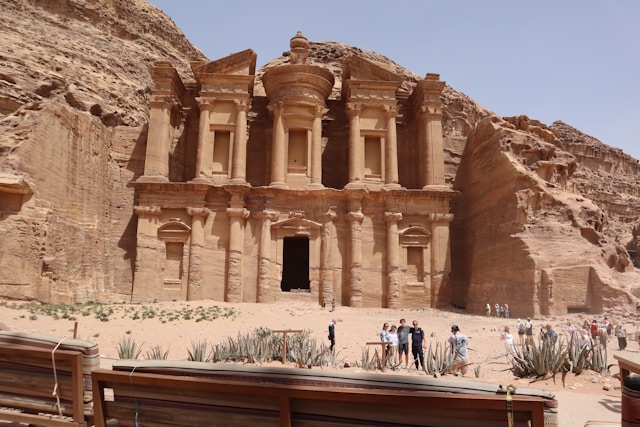
The Royal Tombs reveal much about Nabataean attitudes toward death and the afterlife. Unlike many ancient cultures that concealed their royal burials, the Nabataeans created highly visible monuments, suggesting they viewed death as a public transition worthy of commemoration rather than concealment.
Nabataean funerary inscriptions indicate they believed in a form of afterlife, though details remain limited. Archaeological evidence suggests they practiced secondary burial customs—after decomposition, bones were collected and placed in special repositories within the tombs, often accompanied by valuable grave goods, including jewelry, ceramics, and ritual objects.
The presence of triclinium spaces (formal dining areas) near many tombs indicates that regular commemorative feasts were held to honor the deceased. Such practices reinforced social bonds among the living while maintaining connections with ancestors—a complex spiritual ecosystem typical of ancient Near Eastern cultures.
The orientation of tombs toward the rising sun suggests that solar symbolism played a role in Nabataean cosmology, possibly representing renewal and rebirth. This east-facing alignment is consistent across most major tombs in Petra, indicating a deliberate theological choice rather than mere architectural convenience.
Architectural Techniques and Conservation Challenges
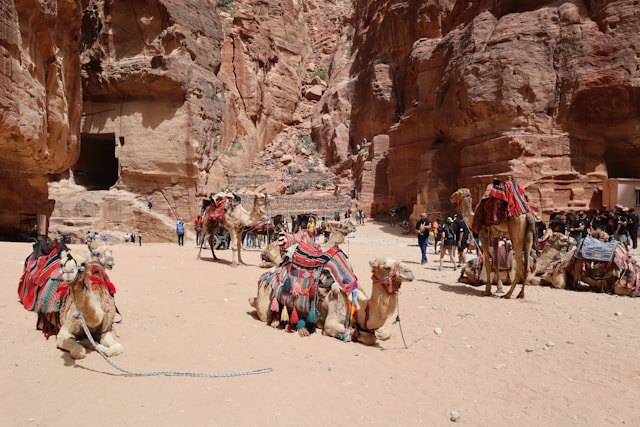
The creation of these monumental structures involved sophisticated engineering. Nabataean stonemasons began carving from the top down, using simple tools such as chisels, hammers, and measuring ropes. Evidence of scaffolding holes remains visible on some façades, providing insights into their construction methods.
The tombs represent negative architecture—spaces created by removing material rather than building up. This technique required exceptional planning and precision, as mistakes could not be corrected. Recent archaeological studies suggest that preliminary designs may have been sketched on the cliff face before carving began.
Today, these masterpieces face significant conservation challenges. Wind erosion, water seepage, salt crystallization, and human impact threaten their preservation. International conservation efforts focus on stabilizing vulnerable areas, managing water runoff, and implementing sustainable tourism practices to protect these irreplaceable monuments for future generations.
Visitor Information: Making the Most of Your Experience
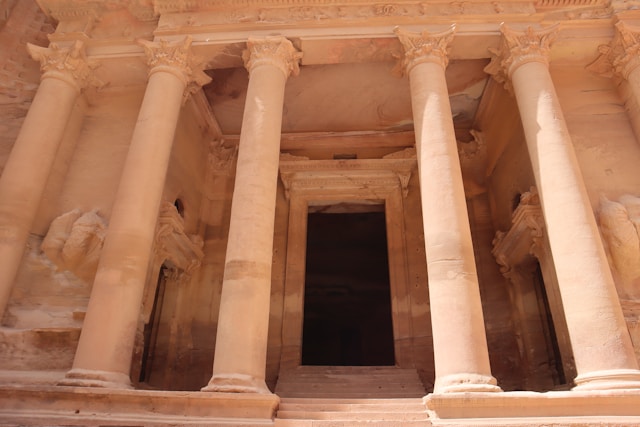
Practical Details
Opening Hours: The Petra Archaeological Park operates from 6:00 AM to 6:00 PM during the summer months (April to October) and from 6:00 AM to 4:00 PM in winter (November to March).
Admission: Entry to the Royal Tombs is included in the Petra Archaeological Park admission fee of 90 JOD (approximately $127) for one-day visitors. Significant discounts apply for overnight visitors to Jordan and those with a Jordan Pass, which combines visa fees and entrance tickets to major attractions.
Optimal Visiting Strategy: The Royal Tombs are best explored in the late afternoon (after 2:00 PM) when most tour groups have departed and the western sunlight illuminates the façades with a golden glow, enhancing their color and detail. This timing also offers more comfortable temperatures, especially during the summer months.
Photography Tips
To capture all four Royal Tombs in a single frame, position yourself in the valley opposite Jabal al-Khubtha, preferably near the Great Temple complex. This vantage point provides the classic panoramic view featured in many travel publications.
The Urn Tomb's courtyard offers exceptional cityscape views across Petra's central valley—bring a wide-angle lens to capture this expansive perspective. For the Silk Tomb, visit during the "golden hour" (the hour after sunrise or before sunset) when slanting sunlight maximizes the vivid colorations of the sandstone.
Hidden Features to Discover about Nabataean Architecture
While exploring the tombs, look for these easily missed details:
- Ancient Nabataean graffiti near the entrance of the Urn Tomb, featuring merchant marks and camel caravan symbols
- The remains of original plaster and paint fragments in the upper corners of the Corinthian Tomb's interior
- Water collection channels ingeniously carved into the cliff face above the Palace Tomb, demonstrating Nabataean water management expertise
- Faint astronomical alignments marked on the ceiling of the Urn Tomb's main chamber, visible only during certain times of the year
Beyond the Royal Tombs: Connected Experiences
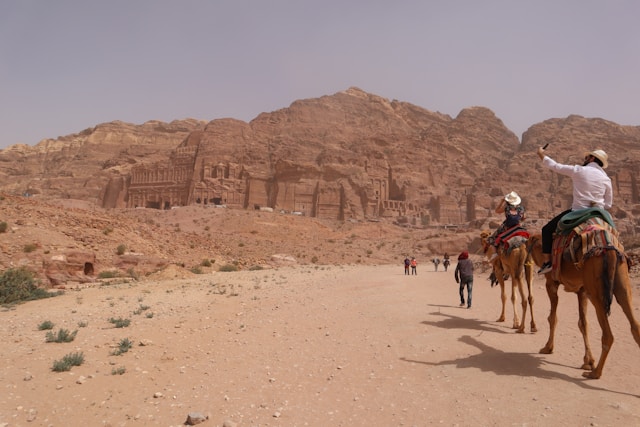
The Royal Tombs represent just one highlight within the larger Petra Archaeological Park. After exploring these magnificent structures, consider these related experiences:
- Hike to the High Place of Sacrifice via the path behind the Royal Tombs for spectacular aerial views
- Visit the newly excavated Winged Lion Temple in the city center to understand Nabataean religious practices
- Explore the Renaissance Tomb and Broken Pediment Tomb in the adjacent Wadi Farasa for examples of less elaborate but equally interesting Nabataean funerary architecture.
- Experience "Petra by Night," held three evenings weekly (Monday, Wednesday, and Thursday at 8:30 PM), when the main path to the Treasury is illuminated by thousands of candles.
The Legacy of the Royal Tombs
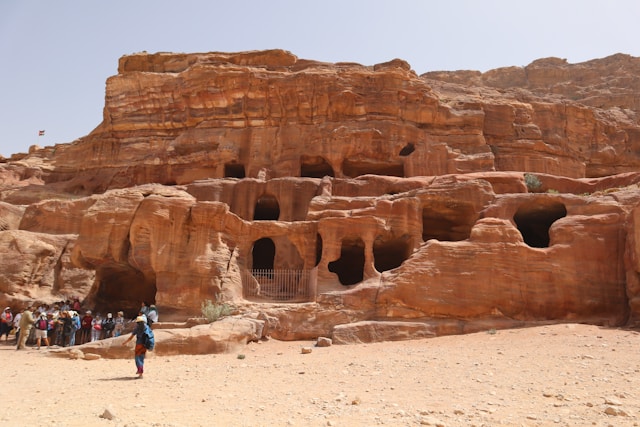
The Royal Tomb group of Petra stand as more than just archaeological wonders—they represent the culmination of Nabataean cultural achievement before the kingdom's absorption into the Roman Empire in 106 AD. Their architectural sophistication challenges simplistic notions about ancient Arabian civilizations and demonstrates the cosmopolitan nature of this trading society.
As you walk among these magnificent structures, you participate in a tradition of admiration spanning two millennia. From ancient Roman visitors to 19th-century European explorers like Johann Ludwig Burckhardt, who rediscovered Petra in 1812, to modern travelers, these monuments have continuously inspired wonder.
Their enduring presence on the landscape—simultaneously dominating yet harmoniously integrated with the natural environment—offers a powerful lesson in architectural humility and vision. In an age of disposable construction, the Royal Tombs remind us of buildings designed not just for decades but for eternity, carved from living rock-cut to ensure their message would reach countless future generations.
As the afternoon light casts lengthening shadows across these ancient façades, take a moment to consider the hands that shaped them, the ceremonies they witnessed, and the civilizations they outlasted. In doing so, you'll experience not just another archaeological site but a profound connection to human creativity and our universal desire to leave a mark that survives our brief existence.
The Royal Tombs Petra Tours
Option 1: Complete Petra Exploration (1-2 Days)
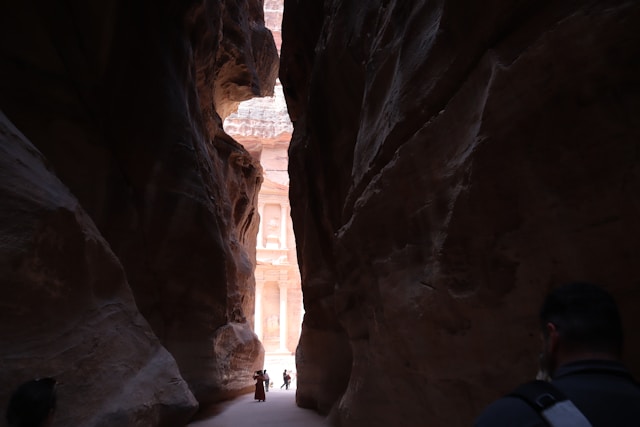
Experience the full majesty of Petra with a focused tour that includes both the iconic Treasury (Khazneh) and the Royal Tombs. Begin at dawn walking through the Siq to witness the Treasury in morning light, then spend the afternoon exploring the Royal Tombs with their spectacular façades. Continue to the Monastery via the ancient stairway for sunset views. Include Little Petra (Siq al-Barid) on day two to see the smaller but well-preserved Nabataean settlement with its notable frescoes, allowing for a comprehensive understanding of Nabataean civilization within its heartland.
Option 2: Petra & Wadi Rum Desert Adventure (3 Days)
Combine the architectural wonders of Petra's Royal Tombs with the natural beauty of Wadi Rum. Spend your first day exploring Petra's main trail and the Royal Tombs, and then travel to Wadi Rum for a sunset jeep safari through stunning desert landscapes. Overnight in a Bedouin camp beneath the stars before returning for a second day in Petra, focusing on its lesser-visited monuments and high places. This combination offers both cultural immersion and natural splendor, connecting the Nabataean city builders with the desert environment that shaped their civilization.
Option 3: Jordan Highlights: Petra, Amman & Dead Sea (4-5 Days)
Begin in Amman, exploring the Roman Theater, Citadel, and Jordan Museum to understand the historical context of ancient Jordan. Travel south to Petra for a full day to the iconic Royal Tombs and Petra visitor centre, then continue to the Dead Sea for a relaxing float in its mineral-rich waters. This comprehensive tour connects Jordan's ancient past with its modern capital. It provides historical context through Amman's museums before experiencing the Nabataean masterpieces at Petra, with luxury relaxation to conclude your journey.
FAQ
How many Royal Tombs are in Petra?
There are four main structures collectively known as the Royal Tombs in Petra: the Urn Tomb, the Silk Tomb, the Corinthian Tomb, and the Palace Tomb. These are carved into the eastern face of Jabal al-Khubtha. While these four are the most prominent and are grouped under the "Royal Tombs" designation, Petra contains over 800 carved tombs throughout the archaeological site.
Who is buried in the Petra tombs?
Despite their name, we don't have definitive evidence of exactly who was buried in this iconic archaeological site. Archaeological evidence suggests they belonged to Nabataean nobility and possibly royalty, but no inscriptions directly name the occupants. The Urn Tomb is believed by some archaeologists to have belonged to King Malchus II (who died around 70 CE) or King Aretas IV, though this remains speculative. The tombs were looted in antiquity, leaving few burial remains to study.
What is the secret tomb found in Petra?
In 2016, archaeologists discovered a large, previously unknown monument hidden beneath the sands of Petra. This structure was not a tomb but a ceremonial platform measuring approximately 56 by 49 feet (17 by 15 meters). It was found using satellite imagery, drone photography, and ground surveys. Unlike the "secret tomb" sometimes mentioned in popular media, this was likely a public ceremonial space rather than a burial site.
Which ancient king was buried in Petra?
While no king's remains have been definitively identified, historical records indicate several Nabataean kings who likely had tombs in Petra, including Aretas IV (ruled 9 BCE- 40 CE), considered Petra's greatest king, and Malichus II (ruled 40-70 CE). The Treasury (El-Khazneh), despite popular myths, was probably not a royal tomb but a temple or memorial dedicated to a king.
Why was Petra abandoned?
Petra's decline and eventual abandonment occurred due to multiple factors:
- Changing trade routes after the Roman annexation of the Nabataean Kingdom in 106 CE redirected commerce away from Petra
- A major earthquake in 363 CE damaged much of the city's infrastructure, including its vital water systems
- The rise of maritime trade routes through the Red Sea reduced the importance of Petra's position on overland trade routes.
- The Byzantine era saw a shift of regional power to other centers
- The Islamic conquest in the 7th century further diminished Petra's importance
- Continued seismic activity in the region made maintaining the city increasingly difficult
By the end of the 8th century CE, Petra was largely abandoned except for a small number of nomadic inhabitants. It remained "lost" to the Western world until its rediscovery by Swiss explorer Johann Ludwig Burckhardt in 1812.
What's inside the Royal Tombs of Petra?
The interiors of the Royal Tombs are relatively simple compared to their elaborate facades:
- The Urn Tomb has a large main chamber with three small burial niches and evidence of its later conversion to a Byzantine church, including three apse niches
- The Silk Tomb has a modest interior chamber with simple burial recesses
- The Corinthian Tomb contains four separate chambers, likely for multiple family members
- The Palace Tomb has four entrance doorways, each leading to its burial chamber
Most tombs feature rectangular chambers cut into the rock with niches or recesses for burials. Any decorative elements or valuable grave goods were removed centuries ago by looters.
What is Little Petra?
Little Petra (Siq al-Barid, meaning "Cold Canyon") is a smaller archaeological site located about 5 miles (8 km) north of the main Petra site. It was likely a suburb of Petra that served as a commercial center and accommodated visitors and traders. Like the main site, it features buildings carved into sandstone cliffs, including:
- Small temples are carved around the site
- Dining halls (triclinia) with well-preserved ceiling frescoes and decorated columns
- Water cisterns and channels
- Merchant storerooms from solid rock
Little Petra is less crowded than the main site and contains some of the best-preserved Nabataean painted frescoes. It's believed to have functioned as a resupply point for caravans and potentially a retreat for wealthy Nabataean merchants. The name "Little Petra" was given by modern visitors due to its architectural similarities to the main Petra site but on a smaller scale.
What is the Sextius Florentinus tomb Petra?
The Sextius Florentinus Tomb in Petra(AKA the Roman Soldier Tomb) is a unique Roman-era monument dedicated to Titus Aninius Sextius Florentinus, who served as the Roman governor of Arabia around 126-130 CE, shortly after Rome annexed the Nabataean Kingdom. What distinguishes this tomb from others in Petra is its clear Latin inscription confirming its occupant—a rarity in Petra where most tombs' owners remain unidentified. Located on the eastern slope of Jabal al-Khubtha, somewhat separate from the Royal Tombs, the structure blends Roman architectural elements (including a classical pediment with decorative acroteria and columns) with Nabataean stonecutting techniques, embodying the cultural transition period when Petra was adapting to Roman rule while maintaining aspects of its native traditions. The tomb represents tangible evidence of Roman administrative presence in the former Nabataean capital and illustrates how Roman elites adopted local burial practices while preserving their cultural identity through familiar architectural features and Latin inscriptions.
VISIT THE ROYAL TOMBS IN PETRA TODAY!
ORDER NOW!

SLAVA BAZARSKY
PHONE: +972 53 4779797
Tours in Israel
- 11 Days Jewish Heritage Tour through Israel
- 3-Day Israel Tour for Seniors - Walk Through the Bible
- 3-Day Jewish Heritage Tour of Israel: Unveiling the Rich Tapestry
- 4 Day Israel Tour Package for Seniors - Easy Individual Pace
- 5 Days Jewish Heritage Tour to Israel: A Journey Through History and Spirituality
- 5-Day Israel Private Tour Package For Seniors With Discounts
- 6-Days Israel Private Tour Package for Seniors
- 7 Day Jewish Heritage Tour to Israel: A Holistic Journey
- 7-Day Israel Tour for Seniors: Discovering History and Culture
- 9-Day Jewish Heritage Tour Through Israel
- Best Israel Tours for Seniors lead by #1 private tour guide
- Christian Holy Land Guided Tour of Israel 2026
- Classic Guided Israel Tour
- Holy Land Tours For Seniors From The USA With Price And Reviews
- ISRAEL: OFFICIAL TOURING ENTRY FOR FAMILIES, SMALL GROUPS COVID 19
- Jewish Heritage Guided Tour
- Volunteer and Solidarity Trips to Israel | 2026/2027 Mission Tours
Daily Tours in Israel
- BATTLE LEGACY TOUR
- Best 3-Day Negev Jeep Tour - Mystery of The Israeli Desert
- Best Eilat to Petra 1 Day Private Tour
- BETHLEHEM AND JERICHO PRIVATE DAY TOUR FROM JERUSALEM & TEL AVIV
- CALIBER 3 GUSH ETZION - ULTIMATE ISRAELI MILITARY ADVENTURE
- CHRISTIAN GALILEE TOUR
- CHRISTIAN JERUSALEM TOUR
- CITY OF DAVID AND UNDERGROUND JERUSALEM TOUR
- CLASSIC PRIVATE JERUSALEM TOUR
- Dead Sea and Masada Private Guide Day Tour, Reviews & Price
- Dead Sea and Masada Private Guided Tour for Seniors
- Dead Sea Relaxation Day Tour
- HAIFA, AKKO AND ROSH-HANIKRA TOUR
- Half Day Tour To Bethlehem From Jerusalem With A Local Guide
- Jerusalem Private Tour for Seniors with Cost & Reviews
- Jerusalem Rooftops And Walls Private Tour: History From A Different Angle
- JORDAN RIVER BAPTISM SITE TOUR
- Judean Desert Area Private Tour - Hiking and Off Road Jeep
- Kibbutz Beeri Solidarity Tour - Support and Volunteer
- Kibbutz Nir Oz Solidarity Tour - Witness October 7th Dark Events
- Levinsky Market Ultimate Tasting Private Tour
- Northern Israel Solidarity Tour: Kiryat Shmona, Kibbutzim & Golan Heights
- October 7th Gaza Envelope Memorial Tour from Tel Aviv | Bear Witness
- Private Tour to Nazareth and Capernaum for Seniors
- Private tours of Acre, Caesarea and Haifa from Tel Aviv Israel: Reviews, Price
- Private Tours of Jerusalem and Bethlehem from Tel Aviv Israel: Reviews, Price
- Private Vip Tour Of The Israel Diamond Exchange Center in Ramat Gan
- RAMAT GAN SAFARI PARK TOUR
- SAFED AND GOLAN HEIGHTS TOUR
- Senior-Friendly Private Tour of Caesarea and Haifa
- TEL AVIV AND JAFFA PRIVATE TOUR
- Tour of the Shephelah for Seniors: Beit Govrin, Maresha, Burma Road
- Touring Nova Music Festival Site, Sderot, The Burnt Cars Compound, And Other Sites Around Gaza Strip Following The 7.10.23 Hamas Attack